Connected Lead Capture for Canadian SMBs
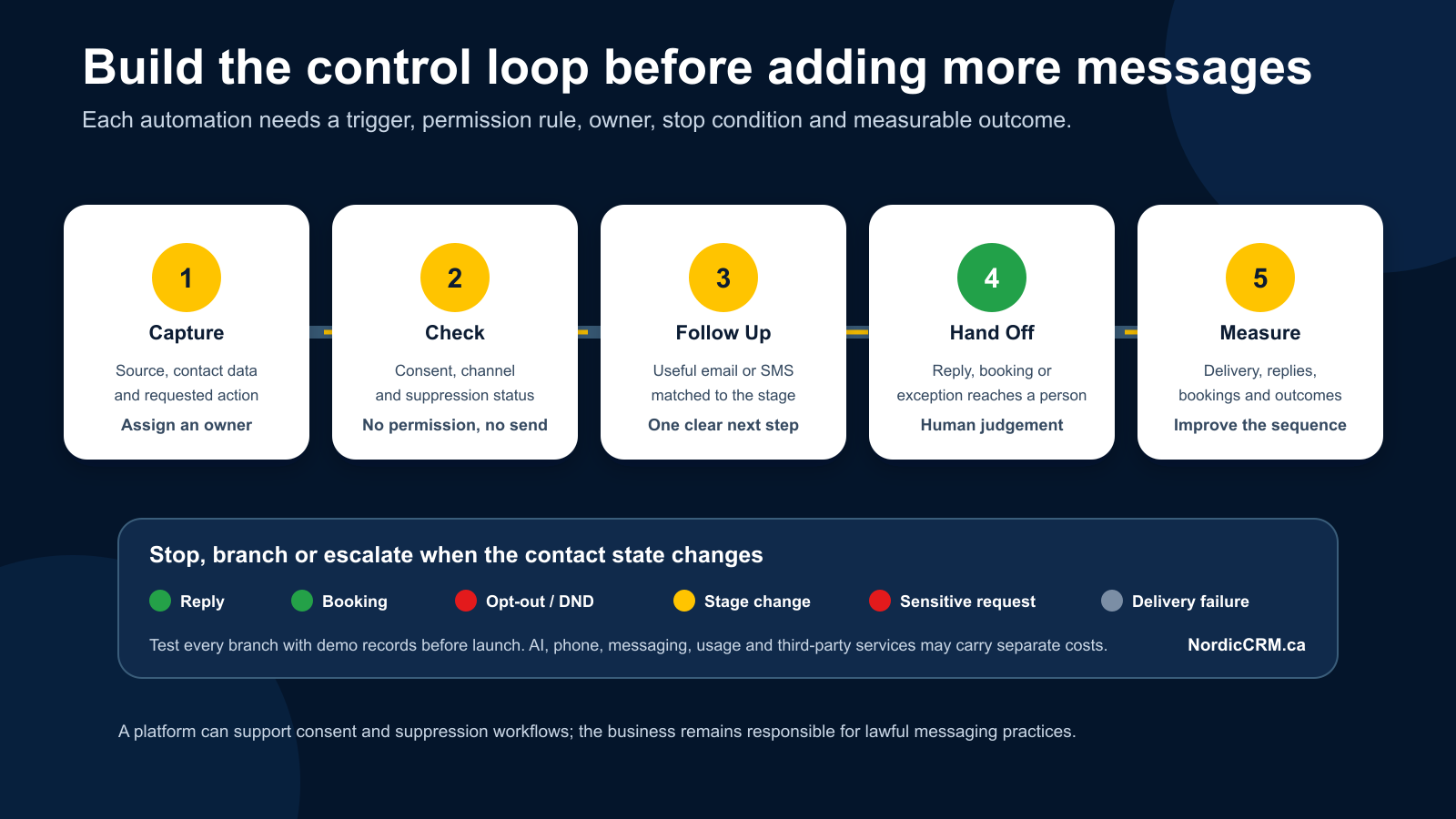
Quick answer: Connect each lead source to one approved capture path, record consent and attribution, assign an owner, offer a useful next step and stop conflicting automation when the person replies, books, opts out or changes status.
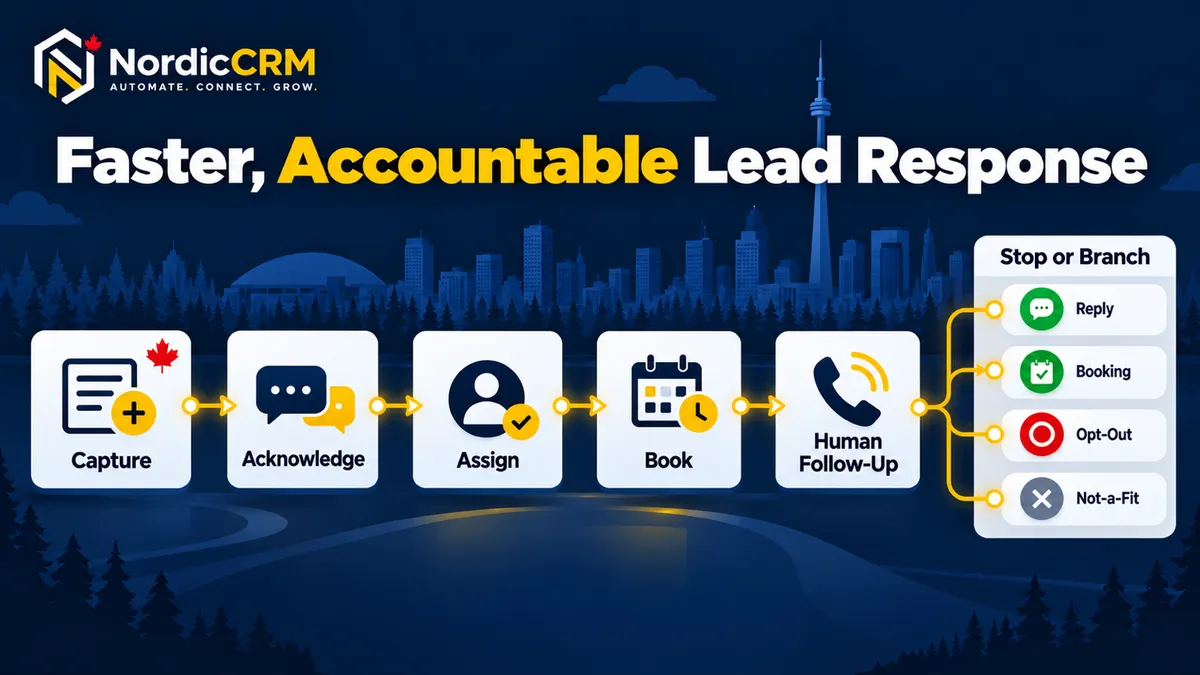
Generating attention is only the start. A lead-capture system must preserve the source, record the request, acknowledge the person, assign an owner and create a clear next step. When those handoffs live in disconnected tools, the team can lose context even when marketing is working.
NordicCRM is powered by HighLevel and configured and supported for NordicCRM customers. Available forms, channels, calendars, workflows and integrations depend on the selected plan, providers, permissions and configuration. Telephone numbers, messaging, email, AI, third-party services and implementation may create additional charges.
The five handoffs that matter
1. Source to capture
Decide where qualified enquiries should arrive: a landing page, contact form, chat, phone call, referral or campaign-specific page. Preserve source and campaign data when it is available. Do not send every visitor to the same vague contact path if the team needs different information or routing.
2. Capture to acknowledgement
Tell the person what was received and what happens next. An acknowledgement is not a claim that a person has reviewed the request. Use realistic response expectations and respect business hours, channel permission and message frequency.
3. Acknowledgement to owner
Every qualified enquiry needs a person or monitored queue responsible for the next action. Assignment rules can help distribute work, but exceptions, failed assignments and uncertain contact matches require review.
4. Owner to next step
Choose one useful next action: reply with a required detail, select an appointment, review a relevant guide or wait for a named person. Avoid sending several competing calls to action.
5. Next step to pipeline outcome
Record whether the enquiry became qualified, booked, attended, proposed, won, lost, disqualified or still needs follow-up. A pipeline should describe real business states, not merely count messages sent.
Build the minimum useful flow
A visitor reaches a service-specific page.
The form collects only the information required for the next step.
The CRM creates or updates the correct contact and preserves the source.
The system checks consent, DND and suppression status.
An appropriate acknowledgement is sent.
The enquiry is assigned to a person or monitored queue.
A task, appointment option or opportunity is created when appropriate.
A reply, booking, opt-out or status change stops or branches the workflow.
The team reviews the outcome and corrects exceptions.
Add channels or messages only after the first path works reliably.
Capture the information the team will use
A form should support the next decision without collecting unnecessary data. Useful fields may include:
name and preferred contact method;
requested service or problem category;
location or service area when relevant;
preferred timing;
lead source and campaign parameters;
consent evidence appropriate to the intended channel; and
notes the customer intentionally provided.
Avoid requesting sensitive personal information unless the business has a legitimate need, an approved system and appropriate safeguards. A general CRM form is not a substitute for a clinical, legal, financial or other specialized record system.
Route by intent, not guesswork
Routing can use explicit information such as the selected service, location, appointment type or existing-customer status. Avoid automated decisions based on protected or sensitive characteristics. When identity or intent is uncertain, send the record to a review queue rather than forcing a match.
The owner should be able to see the original request, source, relevant history and next action without searching several systems. Access should follow job responsibilities, and private information should not be visible to people who do not need it.
Use booking as one possible next step
An embedded calendar can reduce back-and-forth when the service is appropriate for self-booking. It is not the right next step for every enquiry. Confirm the appointment type, duration, availability, time zone, location, buffers, rescheduling rules and human escalation path.
The appointment booking and no-show reduction guide explains how booking statuses and reminders should work together.
Follow up without creating noise
Follow-up should match the reason the person contacted the business. Define:
the permitted channel and purpose of each message;
timing, business-hour rules and the maximum number of attempts;
the owner of a reply;
the events that stop the sequence; and
the path for complaints, uncertainty and sensitive topics.
Do not assume that a form submission permits every future commercial message. NordicCRM can support consent records, unsubscribe handling and suppression, but the business remains responsible for lawful configuration and use. Review the follow-up without spam framework before launching an ongoing sequence.
Connect capture to a real pipeline
The CRM should help the team answer where the enquiry came from, what the person needs, who owns the next action, what happened most recently and what real business state the opportunity is in.
Use the sales pipeline management guide to define stages, owners and exit criteria. For channel ownership and response rules, use the unified inbox guide.
Test the complete journey
Use privacy-safe demo records and test:
each lead source and campaign parameter;
new, existing and duplicate contacts;
valid, missing and withdrawn consent;
required-field and validation errors;
business-hours and after-hours enquiries;
owner assignment and fallback queues;
appointment booking, rescheduling and cancellation;
replies, opt-outs and DND status;
delivery failures and provider interruptions;
opportunity creation and stage changes; and
mobile and desktop form completion.
Confirm what the customer sees, what the owner sees and what happens when a connection fails. A working happy path is not enough.
Measure the operating outcome
valid enquiries by source;
time to first appropriate response during published hours;
assignment failures and unowned enquiries;
qualified replies, booked and completed appointments;
progression by pipeline stage;
delivery failures, opt-outs and complaints; and
duplicate or incorrectly matched records.
Treat attribution as evidence, not proof of causality. Review the full journey and data quality before crediting one page, channel or automation with a result.
Where NordicCRM fits
NordicCRM can connect approved landing pages, forms, contact records, supported conversation channels, calendars, opportunities and workflows within a scoped implementation. The exact design depends on the business process, current data, plan, providers and permissions.
Base subscriptions are billed in CAD. Optional AI products, phone numbers, email or SMS usage, sender registration, third-party services and implementation may be separate. Review the current NordicCRM pricing and AI cost guide and written order before launch.
Frequently asked questions
Do we need a new website to improve lead capture?
Not necessarily. Start by testing the current page, form, source tracking, acknowledgement, ownership and next step. A new page or funnel is useful when the current route cannot support the required journey.
Should every enquiry become an opportunity?
No. Define the qualification point. General questions, support requests, spam and existing-customer service messages may need different paths.
Can automation respond to every lead immediately?
It can acknowledge defined events when the channel, permission, content and provider are configured. Ambiguous, sensitive or high-impact enquiries still need appropriate human review.
Does NordicCRM make our messages CASL-compliant?
No platform guarantees compliance by itself. NordicCRM can support consent records, unsubscribe handling and suppression. The customer remains responsible for lawful data, content, configuration and use and should obtain legal advice where needed.
Which part should we fix first?
Choose the broken handoff that has a clear owner and measurable outcome. Common starting points are unassigned form submissions, missed calls, booking friction or follow-up that continues after a reply.
Review your lead path with NordicCRM
Bring your lead sources, forms, booking process, pipeline stages and current follow-up. NordicCRM can map the handoffs, identify provider and data dependencies and scope a controlled implementation with clear ownership and QA.