
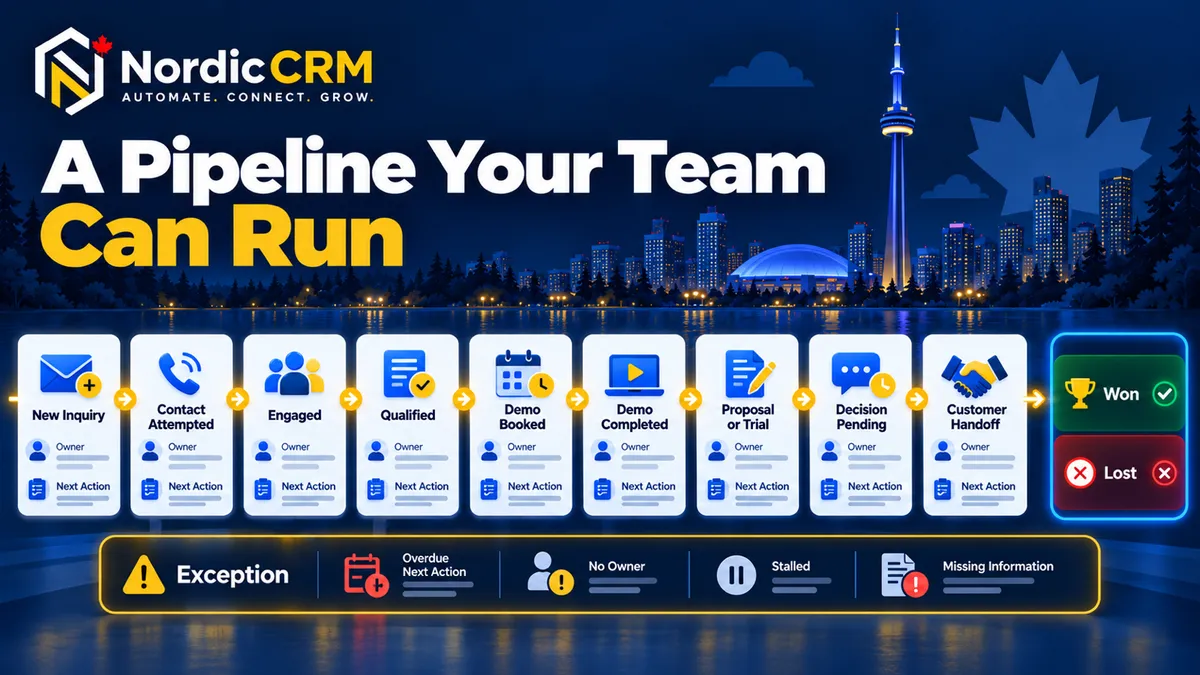
Sales Pipeline Management for Canadian SMBs
Quick answer: Use a small number of evidence-based stages, keep Won and Lost as outcomes, assign one accountable owner, require a next action and connect workflow entry and exit rules to customer behaviour.
Author: NordicCRM Team
Last reviewed: November 2, 2026
Method: Operating-model guidance; no revenue or conversion guarantees.
A pipeline should be easy to explain
More stages do not create more control when people cannot define or operate them. Each stage should represent a meaningful customer state or team responsibility.
Meaning
Define the evidence required before an opportunity can enter the stage.
Owner
Name the person or monitored queue accountable for the next action.
Next action
Require a specific action and realistic due date for every open opportunity.
Exit rule
Document what moves the opportunity forward, backward, Won or Lost.
Communication
State which messages are permitted and when automation must stop.
Exception path
Surface duplicates, unclear ownership and failed automation for human review.
A practical nine-stage model
The model below is a starting point. Your stages should match the decisions and handoffs your team actually makes.
1
New Inquiry
Approved lead event is recorded and ownership is assigned.
2
Contact Attempted
A real outreach attempt is logged with a next action.
3
Engaged
The person has replied or participated in a meaningful conversation.
4
Qualified
Approved fit criteria are met and recorded.
5
Demo Booked
A confirmed appointment is linked to the opportunity.
6
Demo Completed
The meeting outcome and next step are documented.
7
Proposal / Trial
An approved offer or trial has been sent.
8
Decision Pending
The buyer has the information needed and a follow-up date is set.
9
Customer Handoff
An approved Won event initiates onboarding responsibility.
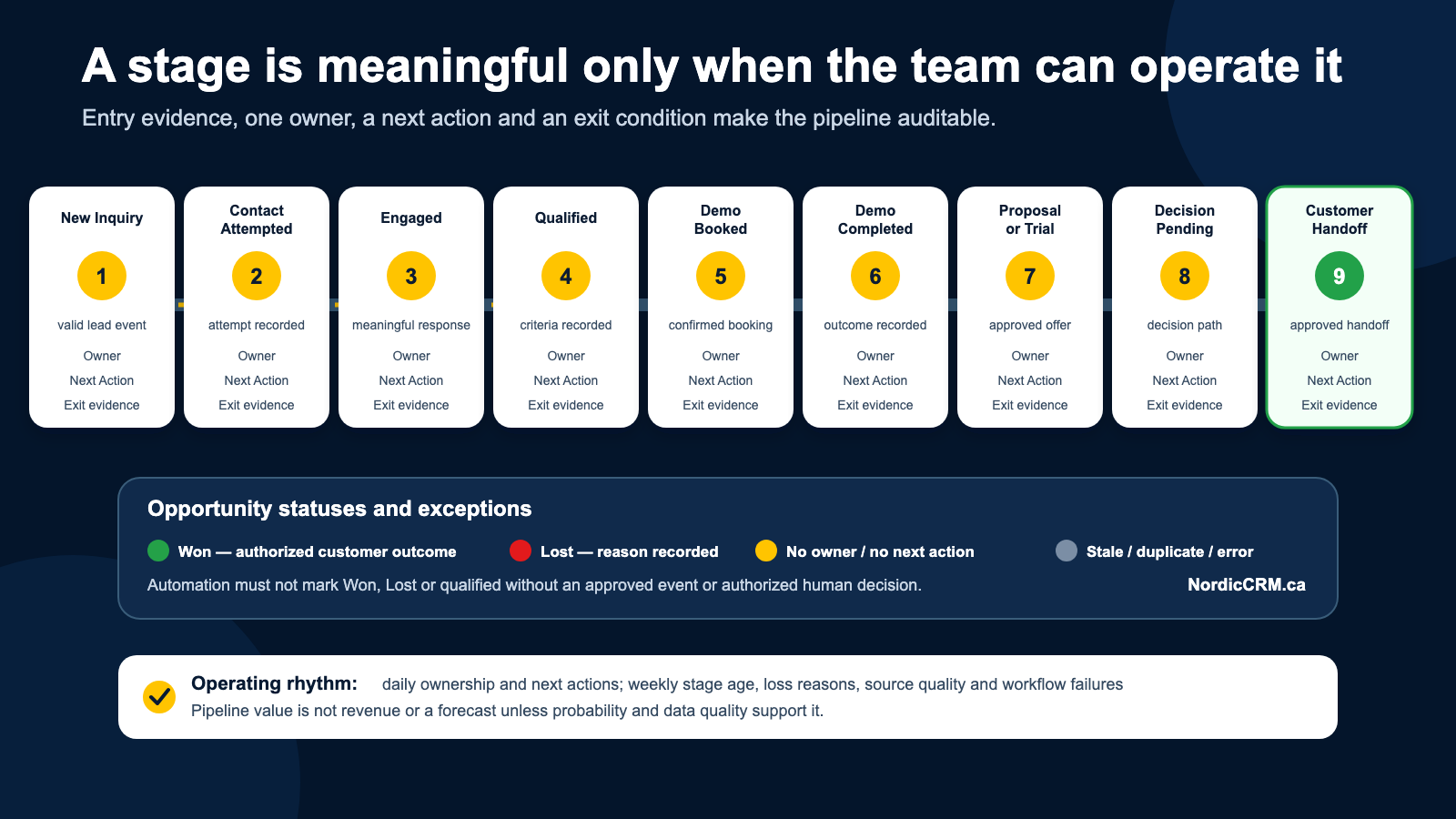
Won and Lost are statuses, not extra pipeline stages. Automation should not decide qualification or final status without an approved event or authorized person.
Opportunity fields that support action
Source and interest
Record the lead source, campaign and service or product interest when known.
Owner and next action
Every open opportunity needs one accountable owner and a dated next step.
Stage and status
Keep the current stage distinct from the open, Won, Lost or abandoned status.
Activity and appointments
Retain last activity, booking state and the next customer or team commitment.
Qualification evidence
Record the reason, not only a label, so decisions can be reviewed.
Lost or disqualified reason
Use clear reasons that help the team improve without inventing certainty.
Automation boundaries
Automation can support | Human or approved-event control |
|---|---|
Create a duplicate-safe opportunity after an approved lead event | Resolve uncertain identity, duplicates and ownership exceptions |
Assign an owner and create a task | Confirm the assignment remains operationally appropriate |
Move to Demo Booked after a confirmed appointment | Review cancellations, no-shows and ambiguous booking states |
Stop promotional follow-up on reply, booking, opt-out, customer status, Won or Lost | Decide how a meaningful reply changes the sales process |
Escalate stale or unowned opportunities | Determine the next action, re-assignment or closure reason |
Notify onboarding after an approved customer handoff | Authorize qualification, Won, Lost and sensitive decisions |
Operate the pipeline daily and weekly
Daily
Review new and unassigned opportunities.
Complete or reschedule overdue next actions.
Process replies, bookings and opt-outs.
Resolve duplicates and data errors.
Weekly
Review stage age and stale opportunities.
Confirm Lost and disqualification reasons.
Reconcile appointments, proposals, trials and handoffs.
Review source quality and workflow failures.
Related guidance: automated lead response, appointment booking workflows and CRM lead-management comparison.
Frequently asked questions
How many pipeline stages should a small business have?
Use the fewest stages that represent meaningful changes in customer state or team responsibility. Each stage needs a clear entry condition, owner action and exit condition.
Should every contact have an opportunity?
No. Create an opportunity only when the contact enters a process the team intends to manage through the pipeline.
Can automation mark opportunities Won or Lost?
Automation should act only on an approved event. Ambiguous qualification and final-status decisions require an authorized person.
Can an AI agent qualify leads?
AI may collect defined information, but the business needs approved criteria, disclosure, human handoff and cost controls. High-impact or ambiguous decisions require human review.
Is total pipeline value a revenue forecast?
Not automatically. Forecasting is only defensible when values, probabilities, stage definitions and data quality support it.
Make the next action visible
Build a pipeline your team can explain.
NordicCRM can map stages, ownership, next actions, suppression and reporting before launch.
Book a pipeline workflow reviewRequest a Professional Services scope
NordicCRM is powered by HighLevel. Features depend on plan and configuration. Communications, AI, phone numbers, usage and third-party services may carry separate charges. Verify current terms and written scope before launch.